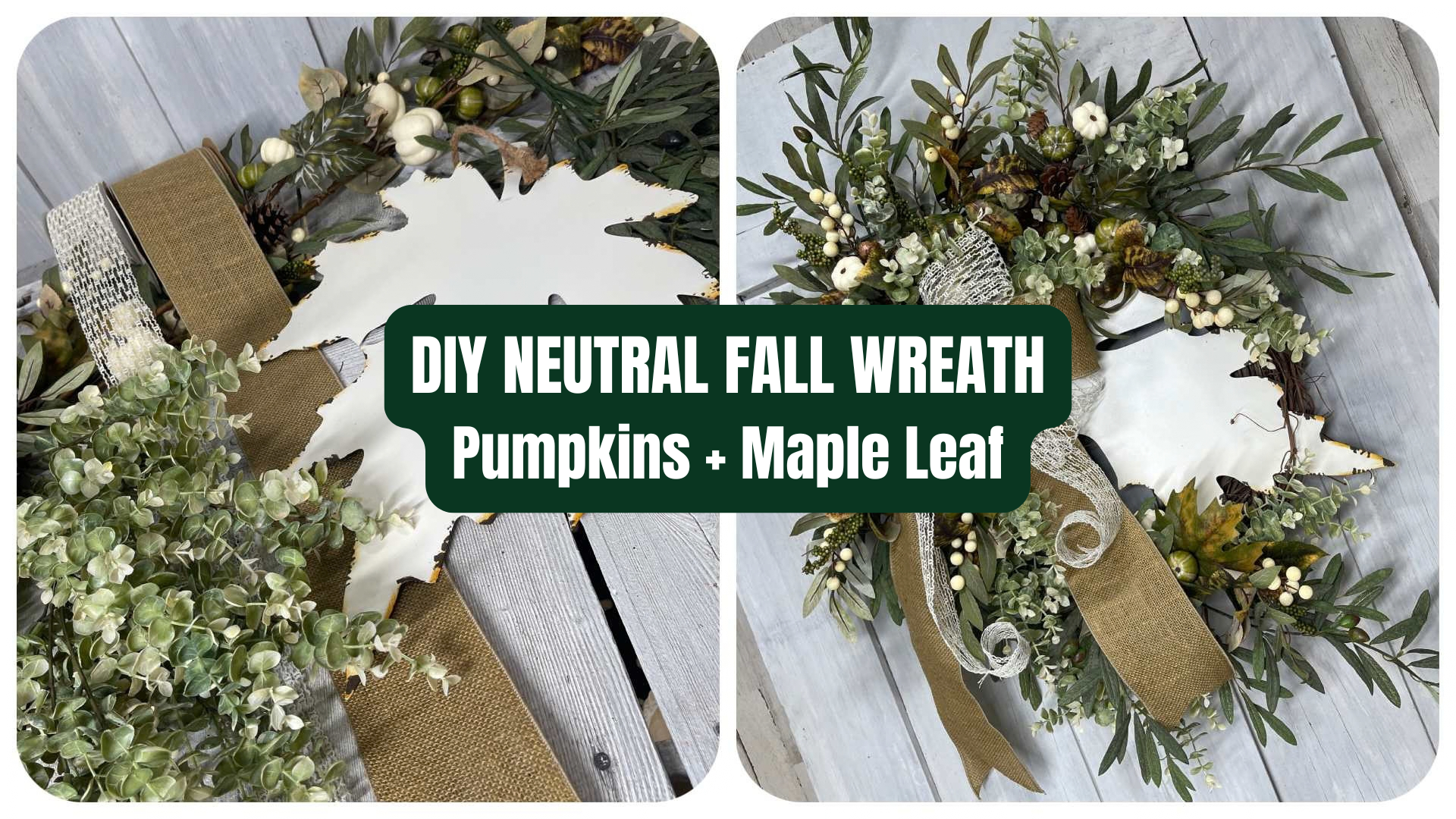
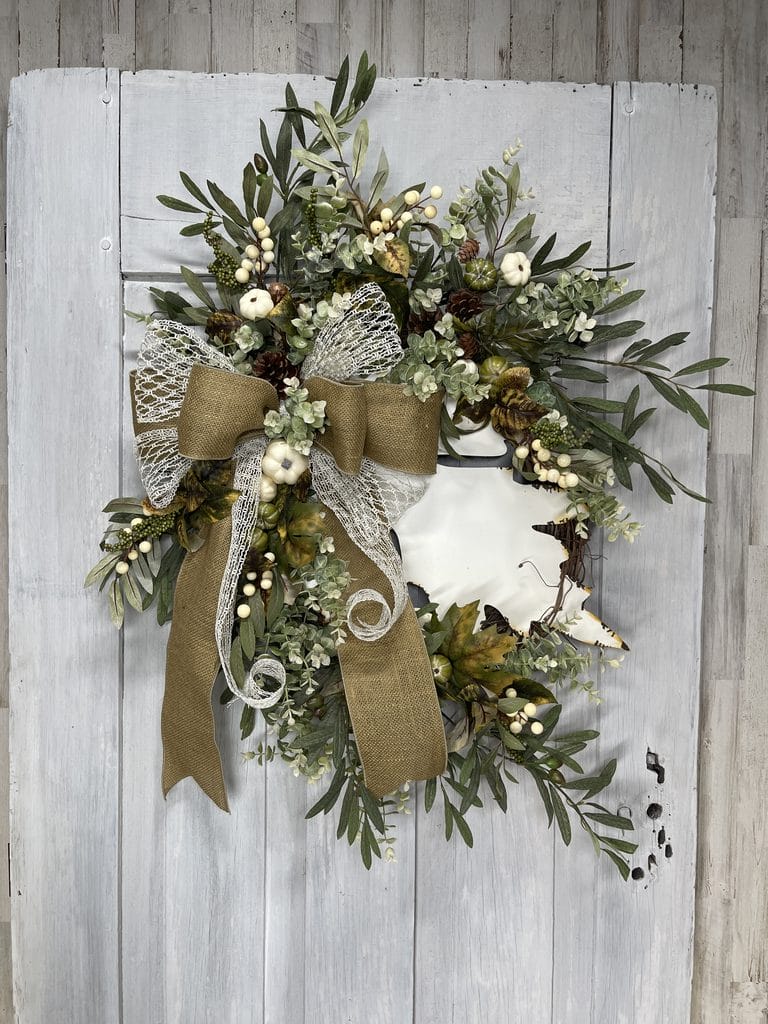
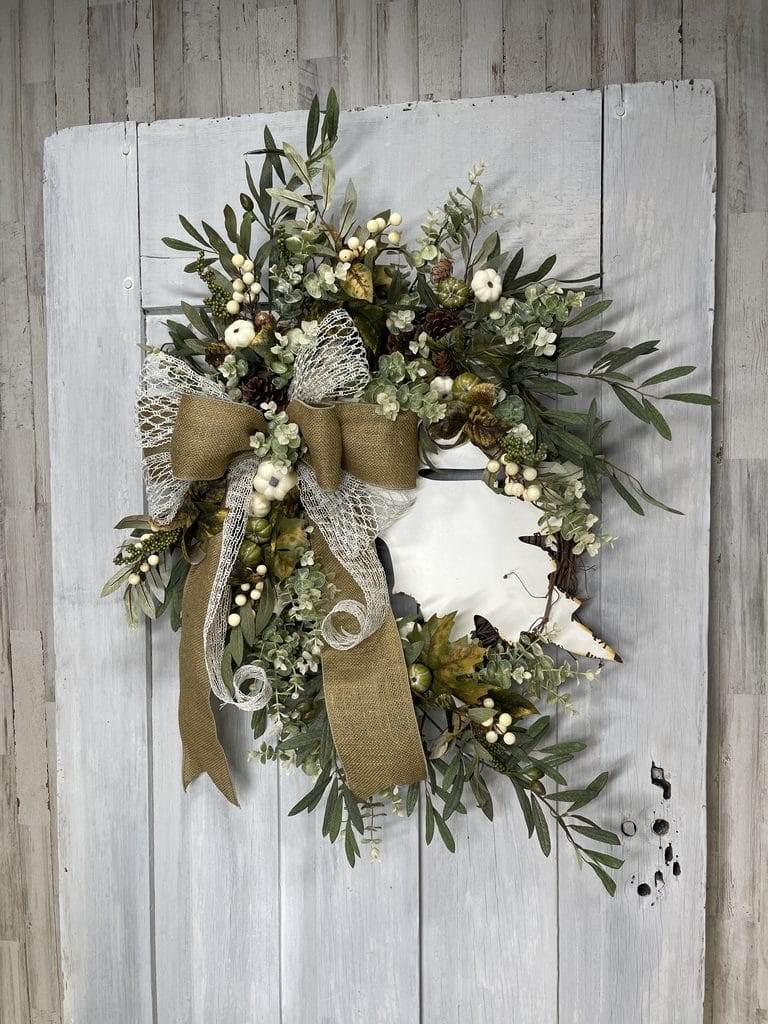
This neutral fall wreath proves that autumn decorating doesn’t need bright orange to make a beautiful seasonal statement. Pumpkins, soft greenery, natural jute and a large maple leaf create a warm cottage-inspired design with plenty of texture and dimension.
Kelea starts with a large maple leaf as the background and lets the pumpkin garland provide much of the autumn color. Eucalyptus and olive greenery connect the softer tones, while ivory and natural jute ribbon keep the finished wreath neutral and classic. Transcript of Maple Leaf and Pu…
➡️ See Kit 1579 and the supply list:
Maple Leaf and Pumpkins Neutral Autumn Wreath Kit
Watch the Neutral Fall Wreath Tutorial
Kelea builds this design on an 18-inch grapevine wreath base, beginning with the maple leaf and then layering the greenery, pumpkin garland, eucalyptus and ribbon around it. The wreath base itself is not included with the kit. Transcript of Maple Leaf and Pu…
Start With the Maple Leaf Background
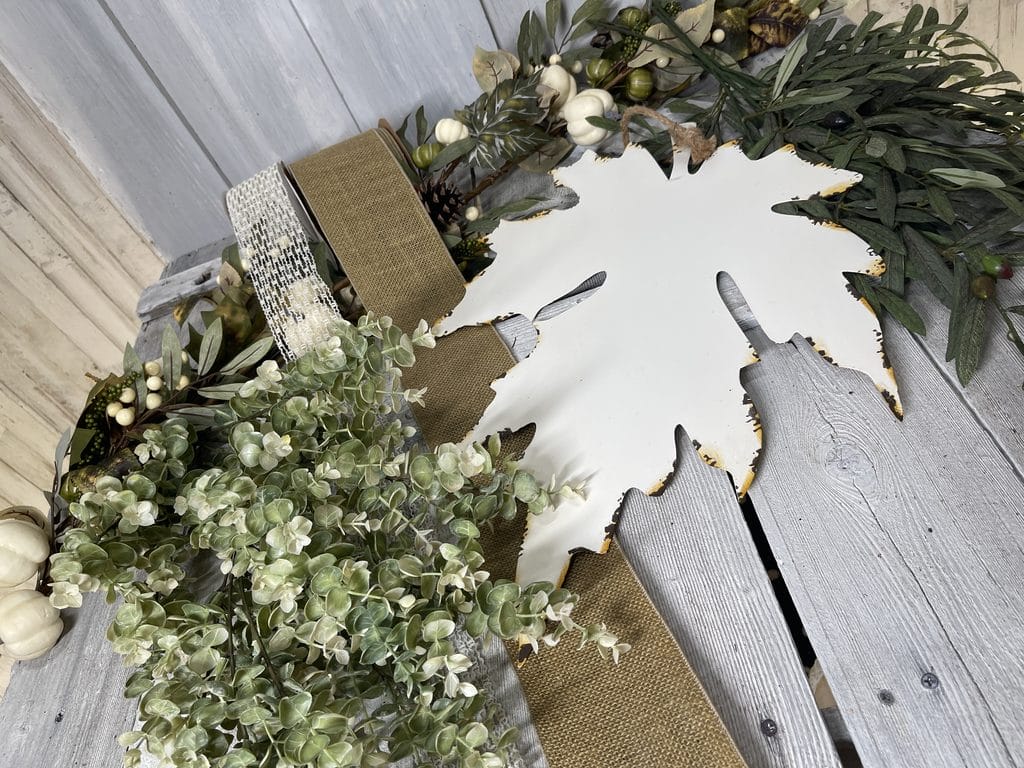
The large maple leaf isn’t simply another decoration added at the end. It establishes the background of the entire design.
Kelea secures the top with a cable tie but also considers what will happen to the bottom once the wreath is hanging vertically.
By working part of the leaf into the grapevine, she keeps it from flapping away from the wreath when it’s hanging on a door. Transcript of Maple Leaf and Pu…
Design for the Door, Not Just the Worktable
That’s a small detail with a bigger lesson behind it.
When you’re building door decor, periodically think about gravity and movement. Something that looks secure while lying flat may behave very differently once it’s hanging vertically.
Establish the Perimeter With Greenery
Before adding all the pumpkins, Kelea establishes the outer shape using olive branches.
She already knows where the bow will go, so that area becomes the transition point. The greenery then moves outward in both directions from that point, establishing the perimeter of the wreath. Transcript of Maple Leaf and Pu…
This gives the design its direction before the heavier focal elements begin filling the space.
What Is a Transition Point in Floral Design?
Kelea describes the transition as the area where a bow, larger floral or another prominent element helps the design change direction. Transcript of Maple Leaf and Pu…
Here, the bow acts almost like a visual hinge.
The materials above it travel one way while the materials below it travel another.
Knowing that transition point ahead of time makes placement much easier.
Cut a Garland Apart to Get More Control
One of my favorite techniques in this wreath is what happens to the pumpkin garland.
Kelea doesn’t simply wrap it around the wreath.
She cuts it apart.
The garland produces six long sections, including larger and smaller pumpkin clusters. Once separated, those sections can be placed exactly where the design needs them. Transcript of Maple Leaf and Pu…
That gives you far more control over spacing and direction than using the garland in its original form.
“Shake Hands” With Every Piece
After separating the garland, Kelea shapes each section before placing it.
That’s her familiar “shake hands with it” technique.
Open the leaves. Separate the pumpkins. Bend wired pieces. Give compressed materials some movement.
You’re not limited to the shape a floral piece had inside its packaging.
Distribute the Pumpkin Clusters
The garland contains different-sized pumpkin clusters, so Kelea plans their placement instead of accidentally putting all the largest pieces together.
She also leaves more of the design below the bow than above it, which contributes to the overall flow. Transcript of Maple Leaf and Pu…
The result feels balanced without being perfectly symmetrical.
Break the Plane of the Maple Leaf
This is one of the strongest teaching points in the entire project.
Kelea deliberately allows the floral materials to extend over the edges of the metal maple leaf.
She calls this breaking the plane. Transcript of Maple Leaf and Pu…
Imagine what would happen if every pumpkin and every piece of greenery stayed perfectly inside the maple leaf.
You’d see two separate things:
a maple leaf + flowers sitting on top of it.
By allowing the florals to cross those edges, the background and floral arrangement visually become one design.
Layer the Eucalyptus Between the Pumpkins and Greenery
After the larger pumpkin sections are established, Kelea adds eucalyptus.
The longer pieces bridge the space between the pumpkin clusters and the outer greenery, creating a softer transition as the materials cascade outward. Transcript of Maple Leaf and Pu…
That’s another useful principle:
When two layers feel disconnected, you may not need more focal pieces.
You may simply need a transitioning texture between them.
Use a Zigzag Placement for Depth
Once the longer eucalyptus pieces are placed, Kelea switches to a zigzag method.
Instead of creating one neat row, she works in, out, in, out while continuing to follow the overall C-shaped movement of the wreath. Transcript of Maple Leaf and Pu…
Some pieces sit deeper in the background.
Others come toward the foreground.
That staggering gives the neutral fall wreath dimension without requiring additional colors or oversized florals.
Don’t Fill the Bow Zone Too Soon
Kelea deliberately stops adding eucalyptus around the transition area because the bow still needs to be attached.
That’s practical design planning.
If you fill every opening first, you may discover that you’ve made your bow much harder to secure. Transcript of Maple Leaf and Pu…
Leave yourself a bow zone while you build.
Then finish the smaller details around it afterward.
Attach the Bow to Something Strong
When Kelea adds the bow, she doesn’t rely on one small piece of grapevine.
She looks for a secure attachment point that will prevent the bow from slipping after the wreath is hung or handled. Transcript of Maple Leaf and Pu…
This is another place where good mechanics matter just as much as pretty placement.
Let Ribbon Continue the Movement
The bow doesn’t stop at the transition point.
Kelea works the ribbon tails down and through the surrounding materials so the ribbon becomes part of the movement of the wreath rather than sitting on top as a separate object. Transcript of Maple Leaf and Pu…
The pumpkins can then tuck around and into the ribbon, further connecting the layers.
Finish Around the Bow Last
Once the bow is secure, Kelea returns to the pieces she intentionally saved.
Small pumpkin sections and eucalyptus are tucked close to the bow to fill specific openings and make the transition area feel finished. Transcript of Maple Leaf and Pu…
This is a much better approach than using every stem early and then trying to fix gaps without anything left to work with.
Save a few pieces for the end.
Why This Neutral Fall Wreath Works
This wreath uses a restrained palette, but it doesn’t feel plain.
That’s because the interest comes from somewhere other than bright color.
The oversized maple leaf provides shape.
Pumpkins establish the autumn theme.
Olive branches create the perimeter.
Eucalyptus connects the layers.
Natural ribbon adds softness.
And staggered placement gives the design depth and movement.
Kelea describes the finished look as subtle but beautiful—and that’s really the strength of this design. Transcript of Maple Leaf and Pu…
Neutral Doesn’t Mean Flat
This is also a good example of why neutral floral design still needs contrast.
When you’re working within a softer palette, pay more attention to:
texture, scale, direction, depth and silhouette.
The pumpkins are rounded.
The olive branches are long and directional.
The eucalyptus adds a different leaf shape.
The jute introduces another texture.
And the maple leaf creates a strong background silhouette.
Those differences give your eye plenty to explore without needing lots of competing colors.
Learn the Why Behind Wreath Design
Techniques like establishing a perimeter, choosing a transition point, breaking the plane and using zigzag placement aren’t limited to this particular wreath.
Once you understand why they work, you can use them with completely different florals, seasons and wreath bases.
That’s what Kelea teaches inside Kelea’s Design School—how to understand placement so you’re not limited to simply copying one finished project.
Learn more about Kelea’s Design School
Neutral Fall Wreath FAQ
What size wreath base is used for this project?
Kelea uses an 18-inch grapevine wreath base. The transcript notes that the base itself isn’t included in the kit. Transcript of Maple Leaf and Pu…
Can I cut apart a pumpkin garland for a wreath?
Yes. That’s a major technique in this project. Kelea cuts the garland into six sections so the pumpkin clusters can be placed independently. Transcript of Maple Leaf and Pu…
What does “breaking the plane” mean?
It means allowing floral materials to cross the visual edge of the base or background element. Here, Kelea overlaps the edges of the maple leaf with pumpkins and foliage so everything reads as one design. Transcript of Maple Leaf and Pu…
What is a transition point?
It’s the area where the direction of the design changes. Kelea explains that a bow or larger floral can mark that transition. Transcript of Maple Leaf and Pu…
Why use zigzag placement?
Moving pieces between foreground and background creates depth while maintaining the overall C-shaped movement of the wreath. Transcript of Maple Leaf and Pu…
What if I can see glue in the grapevine?
Kelea uses Spanish moss to camouflage visible glue and mechanics in open areas of the grapevine. Transcript of Maple Leaf and Pu…
Make Your Own Neutral Fall Wreath
The beauty of this project is that you don’t need a loud palette to create a wreath with plenty of presence.
Start with a strong background.
Establish your perimeter.
Choose your transition point.
Break larger materials into usable sections.
Layer from background to foreground.
Leave space for the bow.
Then finish the smaller openings once the major elements are secure.
The result is a neutral fall wreath with pumpkins, natural textures and enough movement to make the entire design feel connected.
➡️ See Kit 1579 and the complete supply list:
Maple Leaf and Pumpkins Neutral Autumn Wreath Kit